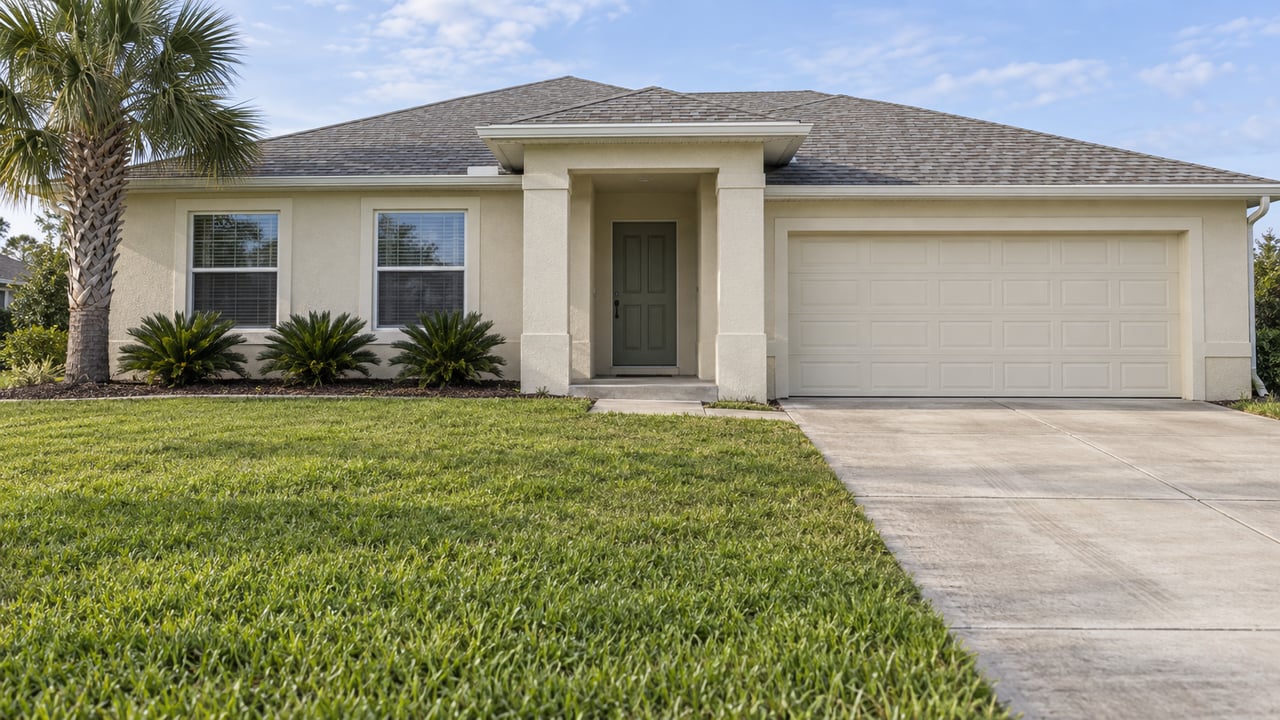
If you buy a home in Port Charlotte's Ackerman Avenue neighborhood this fall, you also take on a sewer assessment. Its yearly amount and its end date are both still undecided. Charlotte County says the assessment is paid in yearly installments on the property tax bill, and "stays with the property once it is sold, and does not need to be paid at the time of sale." Every closing in the project area hands this obligation to the buyer. As of early October 2026, the County Commission has not said how big it will be.
The options on the table answer a narrower question than most coverage suggests. They barely change what each house pays in total. They change how many years the payments last, and that decides how much of the cost a buyer takes over from a seller.
The $575 line on the tax bill was built on an older budget
Charlotte County says the Ackerman Municipal Services Benefit Unit was approved in November 2019. It pays to bring sewer service and new water service lines to about 1,300 properties, plus a vacuum station. The project is split into four zones and a low-pressure sewer section. The original assessment was $575 per year for 20 years, or $11,500 in total.
The budget has grown since then. WINK reported that the project's total budget was about $51.6 million the previous October, and that by May 2026 the County put it at $70.6 million. The County's project page lists the same $70.6 million. That figure includes water-line work.
Staff brought a sewer-only estimate to the Commission's September 15, 2026 workshop. It shows $40,818,279 in project costs and $4,871,512 in financing and administrative costs, minus $8.2 million in grants. Assessments at $575 for 20 years cover $20,240,000 of that, which leaves a shortfall of $17,249,791. Most of the gap is in the later zones. Zones 1 and 2 are short $5,864,386. Zones 3, 4 and the low-pressure area are short $12,592,344, even though $7.2 million of the grant money went there.
So $575 a year no longer covers what each house owes. It is the amount current owners have been paying while the County decides how to close the gap.
Each option gets to about the same total
Staff gave the Commission two approaches. One keeps deferred lots separate. The other folds them into the rate. Each approach comes with three rate choices. For a house where seven years at $575 are credited as already paid, the estimated future yearly amounts look like this:
| House, Scenario 1: maintain deferred lots | Zones 1 & 2 | Zones 3, 4 & LPS |
|---|---|---|
| 1a, "current state" 20-year rate | $740.25 for 13 years | $1,049.37 for 13 years |
| 1b, "affordability" rate | $641.55 for 15 years | $717.99 for 19 years |
| 1c, $575 target | $418.40 for 23 years | $454.73 for 30 years |
Multiply each payment by its number of years and the totals nearly match. In Zones 3, 4 and the low-pressure area, $1,049.37 for 13 years and $454.73 for 30 years each come to about $13,642. Add the seven years already paid at $575 and you reach the County's full per-lot estimate of $17,666.85 for those zones. In Zones 1 and 2, the same math gets to the County's $13,648.25 figure. Under Scenario 1, the rate choice mostly sets how long the payments run and how big each one is.
Total cost is close to fixed, so the length of the schedule decides how much of it lands on a later owner. A seller who leaves after the 13-year option is adopted leaves the buyer a short, steep run of payments. A seller who leaves after the 30-year option is adopted leaves a smaller yearly line that stays on the tax bill for three decades. Scenario 2 moves the numbers around a bit, from $751.60 to $1,169.15 under the 20-year rate and $424.82 to $584.57 under the $575 target. It keeps the same trade between how much per year and how many years.
Vacant lots work differently. Under Scenario 1, deferred vacant lots show $0 for now and pay "the future rate at time of connection." That leaves anyone buying a deferred lot to build on with a cost that won't be priced until the house is built.
Where the decision stands
The workshop deck lists choosing a scenario and a rate as "Direction Needed." The rate choices are the 20-year rate, an affordability target of $903 a year, and a $575 target. After that, the plan calls for a community meeting in the Ackerman area and a public hearing on resolution changes, both "pending BCC direction." Staff also described an online lookup tool where owners could search by address or account number for their estimated future assessment and any deferral status. We found no published decision, hearing date or launched lookup tool as of this writing. The County's project page still describes the September 15 discussion as upcoming.
The uncertainty has been building for a while. WINK spoke with a homeowner who has been paying $575 a year. The homeowner said some people were already selling because they could not afford their homes. In a statement, the County said "No resident has been quoted a 40-year assessment."
Where a given address stands on the ground
How a house connects depends on its zone, and so does who arranges the work:
- Vacuum station: Finished, at 18330 Ackerman Ave.
- Zones 1 and 2: All connections complete.
- Zone 4: Sewer and water mains under construction. Contracted connections are estimated for fall 2026.
- Zone 3 and the low-pressure area: Mains under construction. Contracted connections are estimated for spring 2027.
- South of the Ackerman Waterway: Served by low-pressure sewer, because the waterway rules out vacuum collection there. Utilities is booking appointments to locate septic tanks.
The County notes that the connection schedule assumes ideal conditions and can shift. Construction is forecast to finish on October 3, 2028. In vacuum-sewer areas, the assessment covers the physical connection and the abandonment of one septic tank, so owners don't need to hire a plumber. The low-pressure section has an extra step. The owner hires an electrician to install the County-supplied panel and a dedicated breaker, and the County says the work after that "can take up to 6 weeks or more." A buyer under contract south of the waterway should plan for that electrician's invoice.
How the bill splits at closing
The Florida Realtors/Florida Bar residential contract has a default for assessments paid in installments: "Seller shall pay installments due prior to Closing and Buyer shall pay installments due after Closing." Installments for the year of closing are prorated. If neither option is checked, that default applies. The alternative option has the seller pay off, at or before closing, any assessment the public body allows to be prepaid. Paragraph 9(f) of the "AS IS" form sets this out, and it is still worth confirming which box is checked on the contract you sign.
Under the default, every installment after closing belongs to the buyer, at whatever rate the Commission adopts. Prepayment is the other route the contract offers. The Commission's workshop materials listed properties that have already paid in full as a separate category.
Standard tax disclosure won't flag this. The property tax summary required under Fla. Stat. 689.261 deals with ad valorem reassessment, not special assessments. Florida Realtors summarizes the Johnson v. Davis rule as requiring sellers to disclose known facts that materially affect value and aren't readily observable, including in "as is" sales. How that rule applies to a particular assessment is a question for a real estate attorney.
Outside Ackerman, the cost comes due sooner
Ackerman spreads its cost over years. Homes elsewhere in the county that are close to existing lines face mandatory connection notices instead. Gulfshore Business reported that more than 300 property owners received letters giving them 365 days to pay the wastewater connection fee and 180 days to pay the water fee. A lien would be placed on the property if payment didn't arrive in time. Those notices quoted $17,596 for wastewater and $9,118 for water. The fees had been $11,200 and $6,792 before the April 1, 2026 rate increase.
On July 23, 2026, commissioners voted 5–0 to return those rates to the pre-April 1 levels and 5–0 to hold off on mailing mandatory-connection notices until financing options were considered. Owners who had paid the higher fees are to receive refunds. Staff planned to bring a loan program back in September. At that meeting, Commissioner Stephen R. Deutsch urged homebuyers to review closing documents carefully for utility connection requirements.
More areas are lined up. Lakeview/Midway is the next named Port Charlotte expansion. It covers the Lakeview Boulevard area north from Cochran Boulevard, east to U.S. 41 and south to the Kiwanis Park area. Its plans are at 60% review, and construction funding and timing are undetermined. A September 2026 County presentation lists Murdock, East of Murdock, Wintergarden, Orlando Boulevard, Kensworth and Port Charlotte's Gibraltar Avenue as septic-to-sewer planning areas. For a house still on septic in one of those areas, the eventual connection cost is real even though no one has set a figure.
Questions to settle before you sign
- Is the parcel inside the Ackerman MSBU, and which zone or section is it in?
- Is the assessment already paid off, deferred, or tied to a unity of title agreement?
- Which installment option does the contract select, and does it allow prepayment?
- For a home outside Ackerman, has a mandatory connection notice been mailed, and has any fee been paid?
- South of the Ackerman Waterway, has the electrical panel been installed and has it passed inspection?
The County's Capital Projects Office answers Ackerman questions at 941.764.4560 or [email protected].
Quick answers
Does the Ackerman assessment have to be paid off at closing? No. The County says it stays with the property and doesn't need to be paid at the time of sale. The contract can still assign it differently.
When will the new rate be known? No adopted rate had been published as of early October 2026. The next steps the County outlined are Commission direction, a community meeting and a public hearing.
Does a lower yearly figure mean a cheaper house? For the scenarios presented in September, no. The total per house stays close to the County's per-lot estimate, and a lower yearly figure means more years of payments.
If you're weighing a home in or near the Ackerman project, or listing one, Danene Bazon Meyer can help you find out where the assessment stands for that parcel and work out how the contract should handle it, including on closings managed from out of state. Let's Connect.
This article is general information, not legal, tax or financial advice. Consult a qualified professional about your situation.